Flora canaria > Especies silvestres
Acer pseudoplatanus
Acer pseudoplatanus L.
Familia
ACERACEAE
A large deciduous tree belonging to the Sapindaceae family. It is native to central and southern Europe, as well as to western Asia, and is notable for its remarkable resistance to wind and coastal environments.
It can reach heights of between 30 and 40 metres. It develops a broad, dense, globular crown.
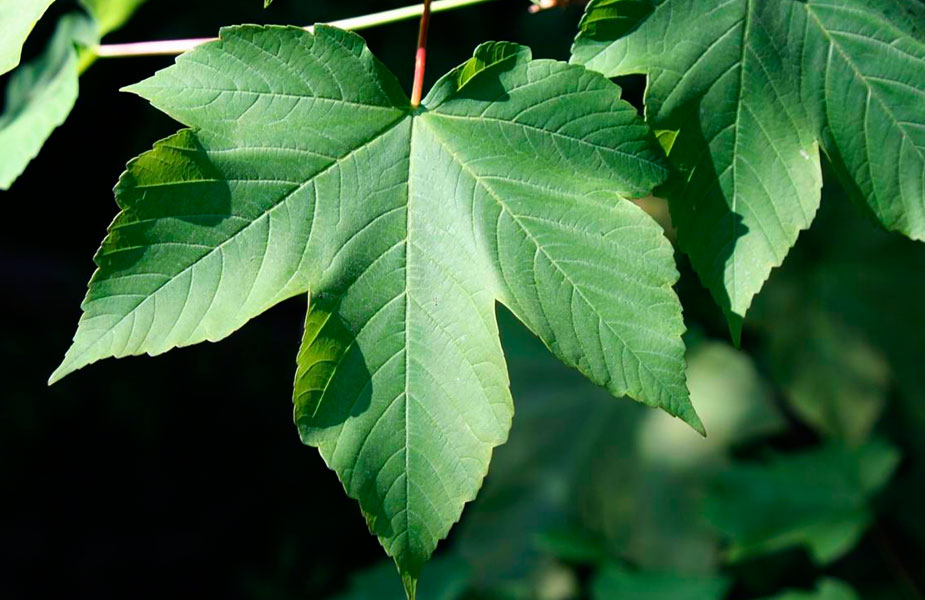
The leaves are palmate and divided into five lobes, with serrated edges. They are dark green on the upper surface and a paler or glaucous shade on the underside. Their petioles are usually reddish in colour.
The bark of young trees is smooth and greyish in colour, but as the tree ages it cracks and flakes off in large scales or plates, revealing patches of orange or brown.
Its fruits are samaras (double-winged seeds) that form an angle of nearly 90 degrees, enabling them to be easily dispersed by the wind as they spin like helicopters.
Due to its rapid growth and leafy canopy, it is frequently used for ornamental purposes in large parks, along city avenues and as windbreaks. Its wood is light in colour, of excellent quality and highly prized for cabinet-making, woodturning and the manufacture of musical instruments.
Gran Canaria