Canary Flora > Wild species
Acer campestre
Acer campestre L.
Familia
ACERACEAE
A medium-sized deciduous tree belonging to the Sapindaceae family. It is native to much of Europe, North Africa and Western Asia, and is highly prized in landscaping for its hardiness, its resilience in urban environments and its ability to tolerate pruning.
It usually reaches a height of between 10 and 15 metres. It develops a dense crown, often rounded or irregular in shape. Its bark has longitudinal fissures and a texture that sometimes becomes corky.
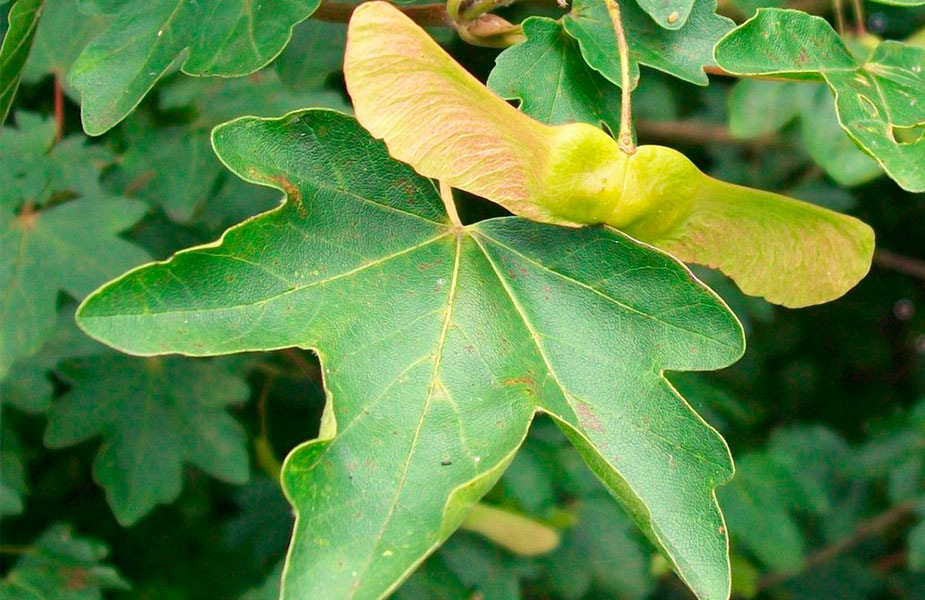
The leaves are opposite and palmate, with 3 or 5 blunt (rounded) lobes. During spring and summer they are dark green, but in autumn they turn a striking golden-yellow or coppery colour before falling.
It produces small, yellowish-green flowers that bloom in spring. Its fruit is a dysamary (two winged seeds joined together), the wings of which are arranged in a distinctly horizontal or divergent manner at 180 degrees.
Medicinal properties: astringent, mild anti-cholesterolemic. The bark is used; it is dried in the sun and stored in a dry place, usually in the form of a decoction.
A species prized in joinery for its fine grain and very light colour; it is highly resistant to insect attack. Through defoliation, veneers are produced which are used in cabinet-making for their marbled pattern. A honey-producing species, used in beekeeping. In cosmetics, it is used to treat reddened skin. In Alsace, maple branches are hung above the front door of houses to ward off bats.
Tenerife