Canary Flora > Wild species
Ipomoea indica
Ipomoea indica (Burm.) Merr.
Familia
CONVOLVULACEAE
Campanita, batatilla de Indias, maravilla
Description: A perennial climbing plant,
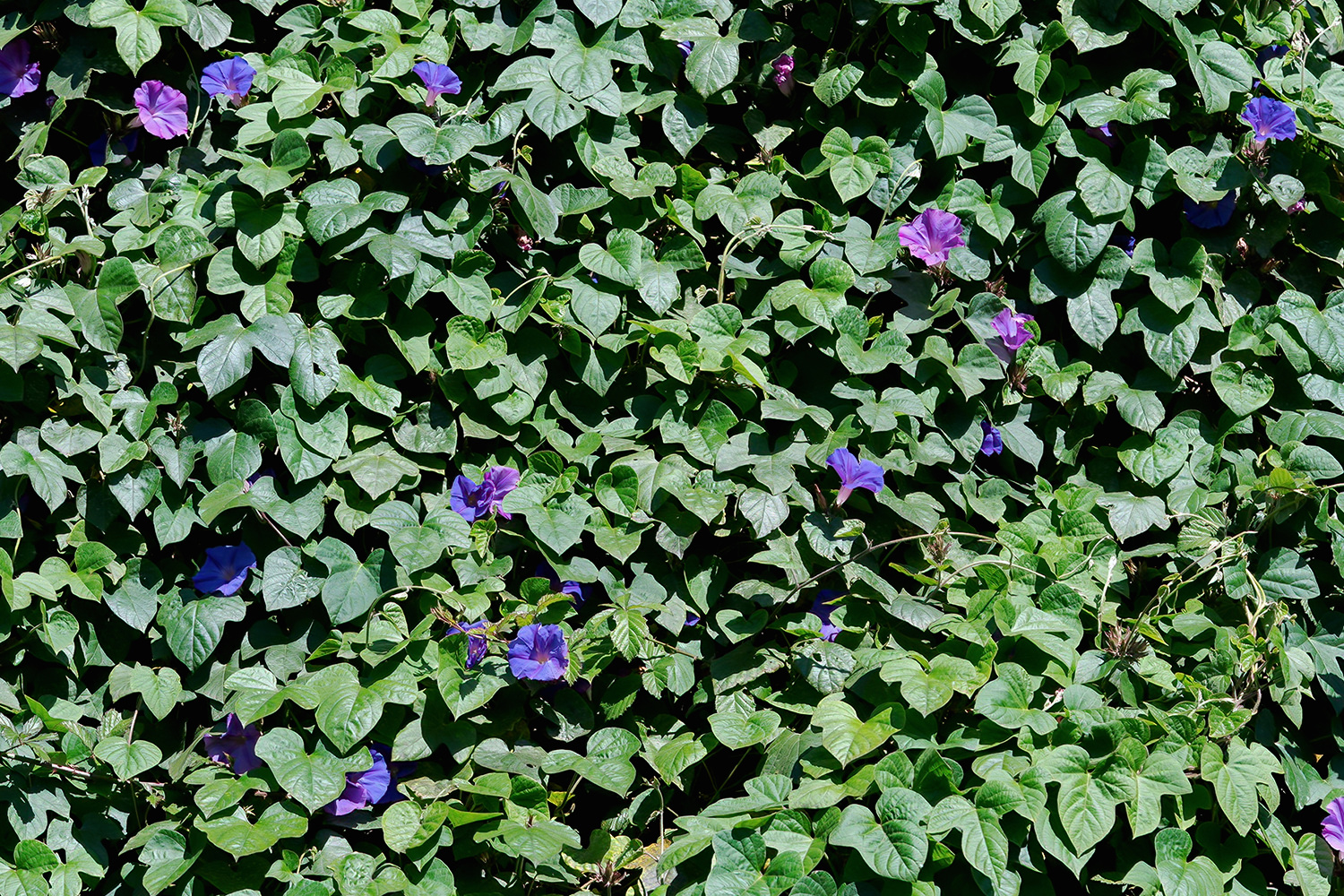
whose branches can grow to over 6 metres in length and form large stands
covering several tens of square metres, sweeping away all vegetation in its
path.
Its leaves, which are deep green and up to 15 cm long, are simple, alternate, long-petiolate, broadly ovate, entire, three-lobed or even five-lobed, cordate at the base, acute or acuminate at the apex, and covered with short, slightly rough hairs, particularly on the underside.
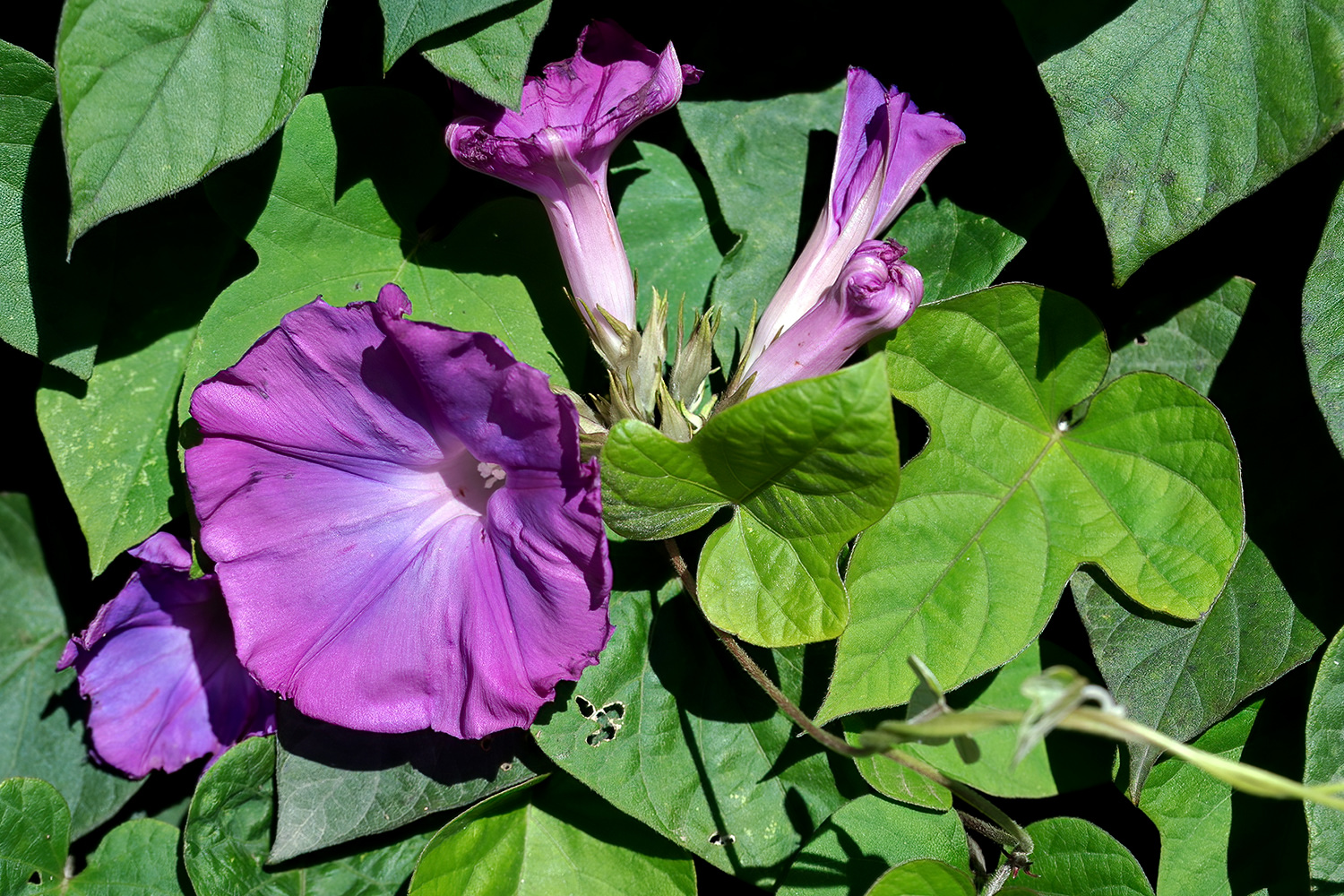
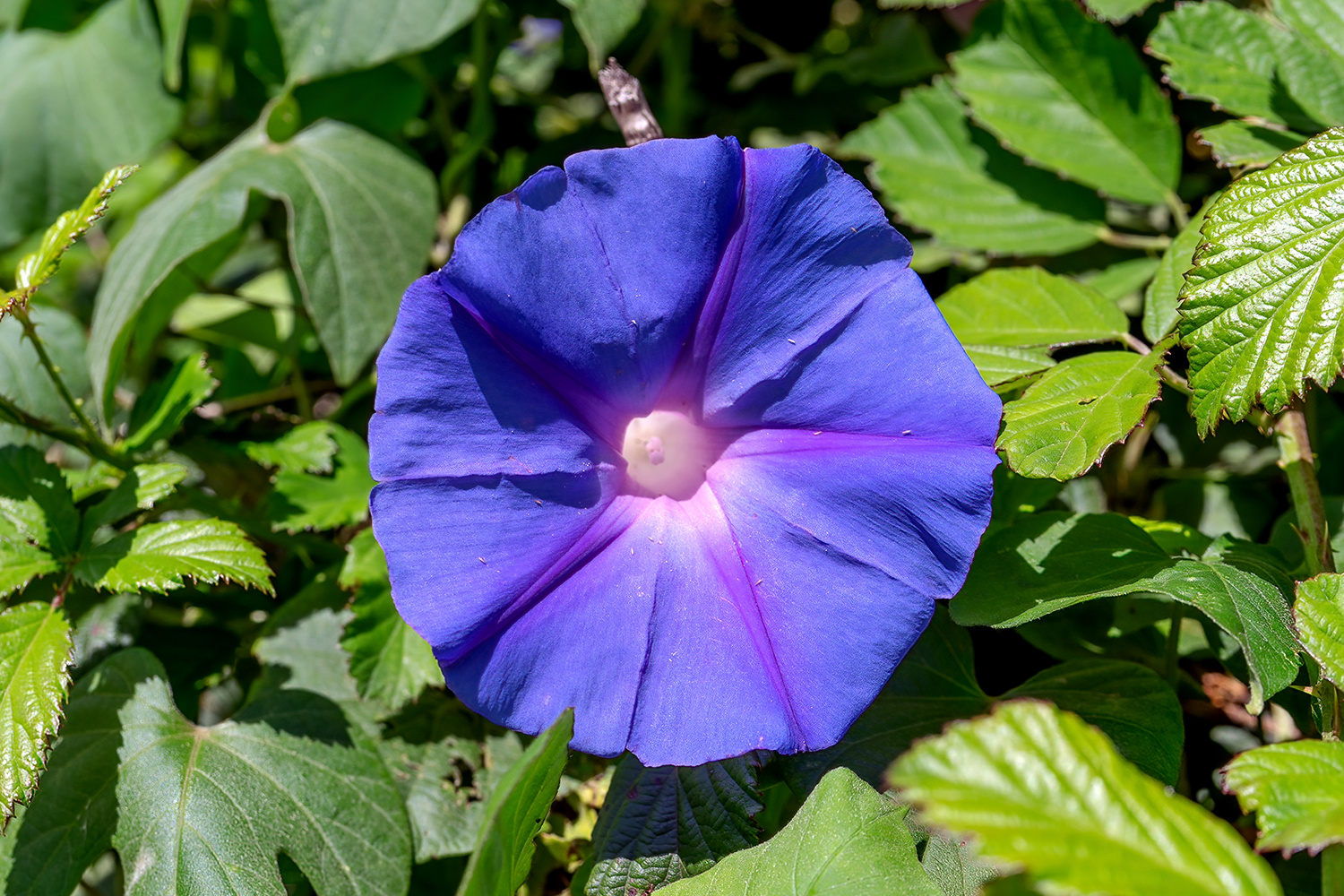
Its attractive flowers, varying in colour from pale pink to deep violet and generally bluish, are grouped in clusters of 3–12, arising from long axillary peduncles up to 20 cm long.
They have a sparsely hairy calyx formed by slightly unequal sepals, the outer ones being longer and slightly wider than the inner ones; they are herbaceous, lanceolate, acute, with marked veining, pubescent (more densely so at the base), whilst the innermost ones are almost glabrous, and a broad, funnel-shaped corolla, about 5–8 cm in diameter, with a throat that is paler in colour than the rest, and on which five radial lines are clearly visible; these are slightly different in colour to the rest of the flower and serve to guide the insects responsible for pollinating this plant.
The stamens are unequal in length, about 3 cm long, and never protrude beyond the corolla. The style is slightly longer, glabrous, rounded in shape and slightly three-lobed. The fruit is a subglobose, slightly compressed capsule, with three chambers containing angular seeds about 5 mm long, black in colour and somewhat tomentose.
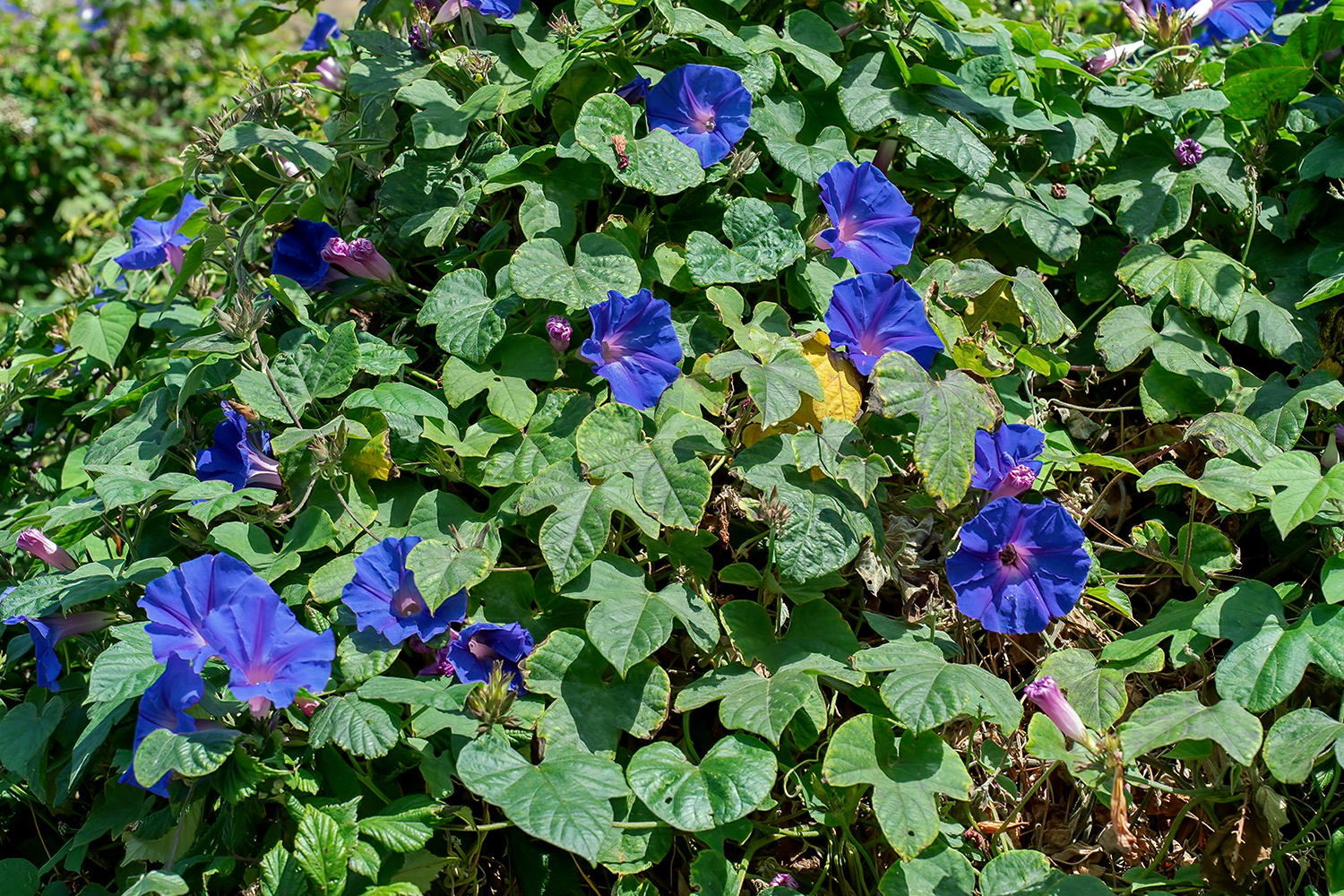
Habitat: In the Canary Islands, it
grows wild on farmland and in ruderal areas, along track edges, in
ravines, scrubland and other locations in the lowlands and mid-altitude
areas. Under very favourable conditions – with fertile soil, moisture
and plenty of sunshine – it spreads rapidly, forming dense and extensive
scrub that colonises and smothers the surrounding vegetation.
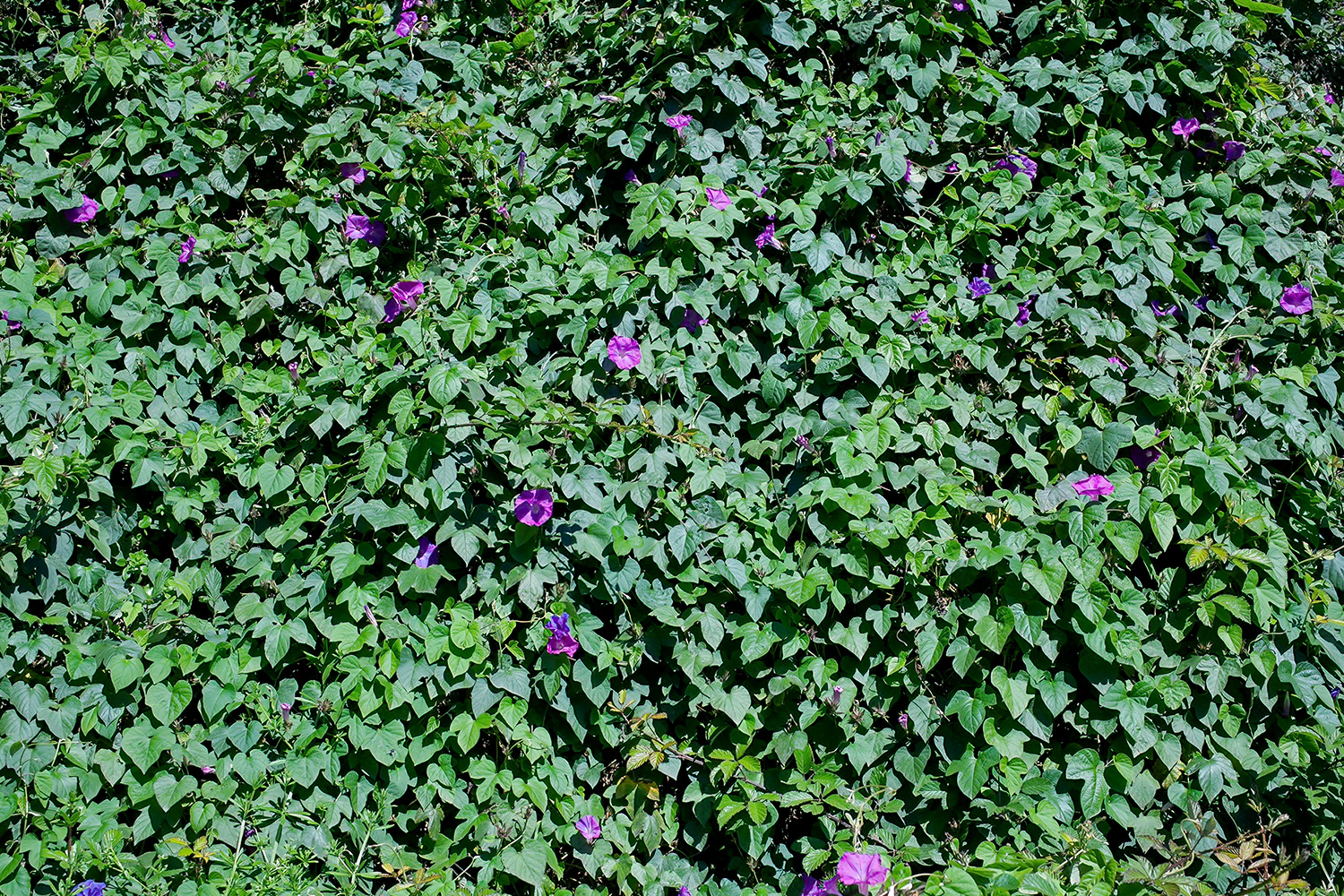
Flowering: Flowering takes place
during the spring and summer months, although in very favourable
locations, flowering specimens can be seen almost all year round.
Propagation: t reproduces via seeds, stolons and stem cuttings. Seeds are spread mainly by the wind, rain and human activity. Stem cuttings root easily and sprout vigorously when cut. Thanks to their fast-growing stolons, they form dense mats on the ground which they invade.
Uses: It is used as an ornamental plant, although care must be taken when choosing where to plant it, as once it has taken root in a spot it is very difficult to remove, given that its tuberous roots penetrate any crack and sprout again with astonishing speed – and with even greater vigour – even after the most thorough weeding. It grows at a very rapid rate, quickly covering walls and fences with its slender, twining, creeping stems that climb almost any support.
It is perfect for covering fences, trellises and pergolas in a short space of time, another reason why it has been used so extensively in gardening. However, it is precisely its rapid growth rate and its ability to cover large areas that make it a very dangerous plant, as it takes over everything in its path, smothering other species until they are completely covered.