Canary Flora > Wild species
Aeonium haworthii
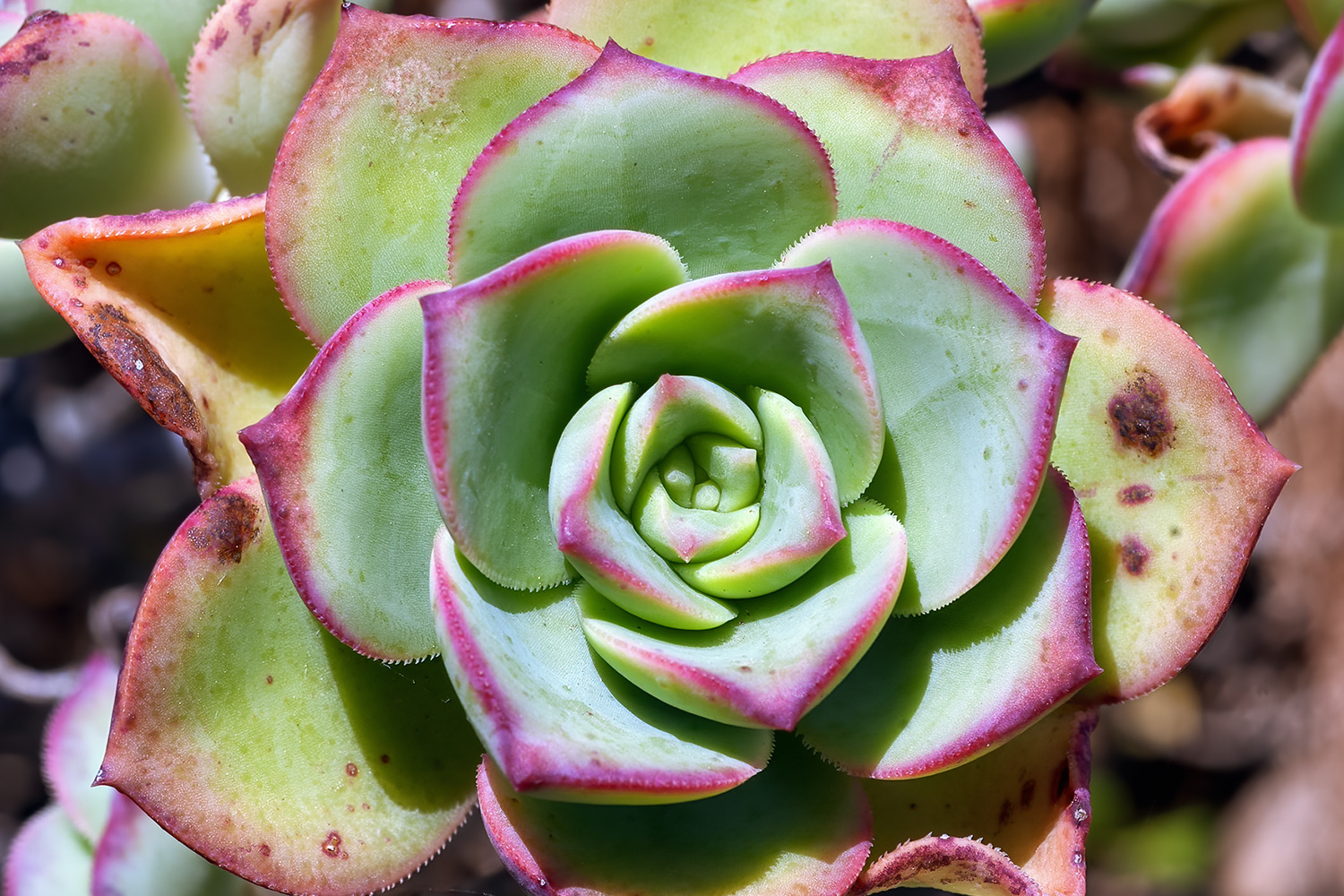
Aeonium haworthii (Salm.-Dyck. ex Webb & Berth.) Webb & Berth.
Familia
CRASSULACEAE
Bejeque de Teno, bejequillo
Description: A small succulent shrub,
usually between 20 and 40 cm tall, profusely branched and with a more or
less stocky habit, which grows on rocky slopes exposed to strong winds, and
therefore develops powerful roots to cling firmly to the ground.
Its stems are slender, brittle and rough to the touch due to the scars left by dead leaves, and quite frequently produce numerous, slender adventitious roots.
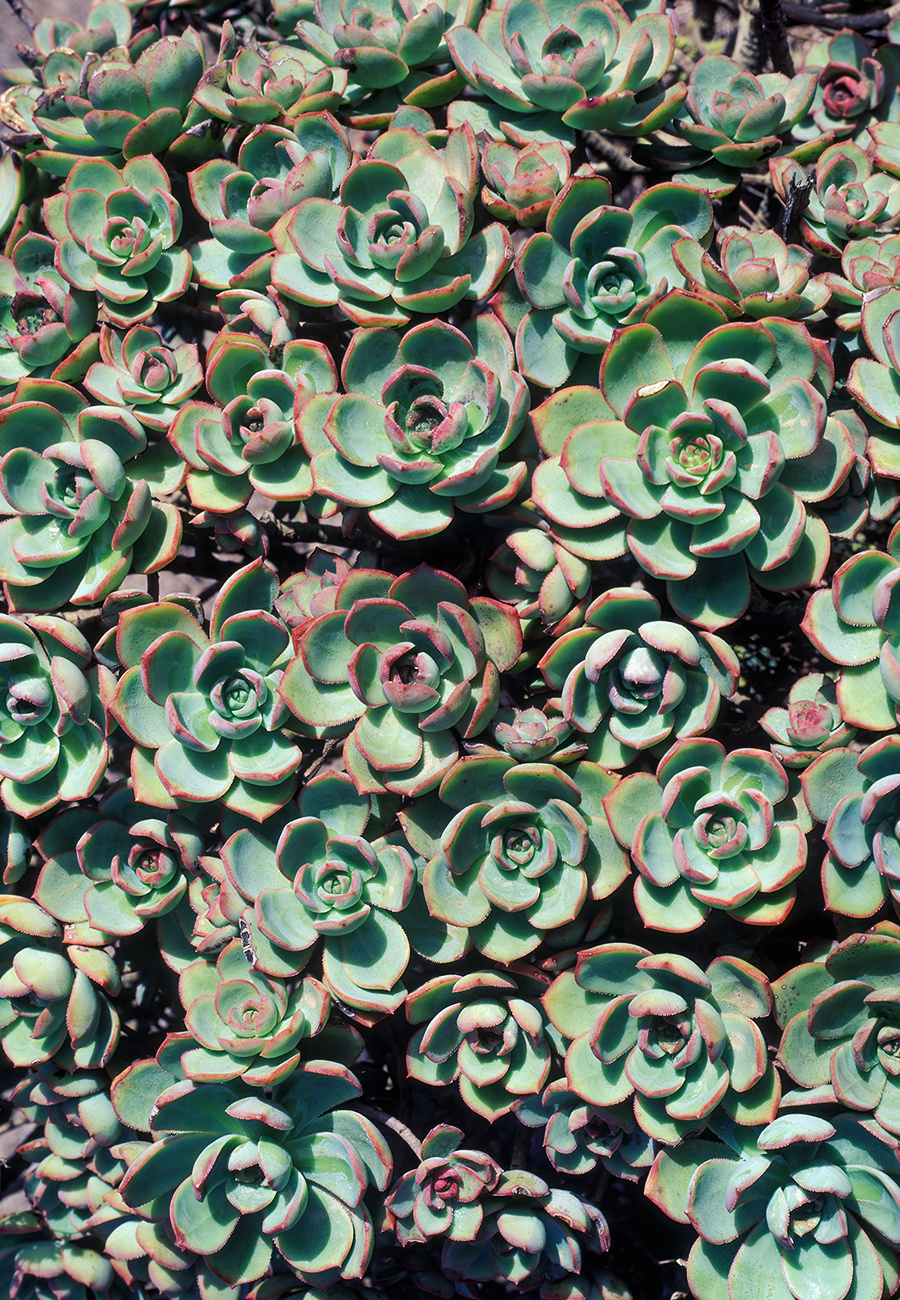
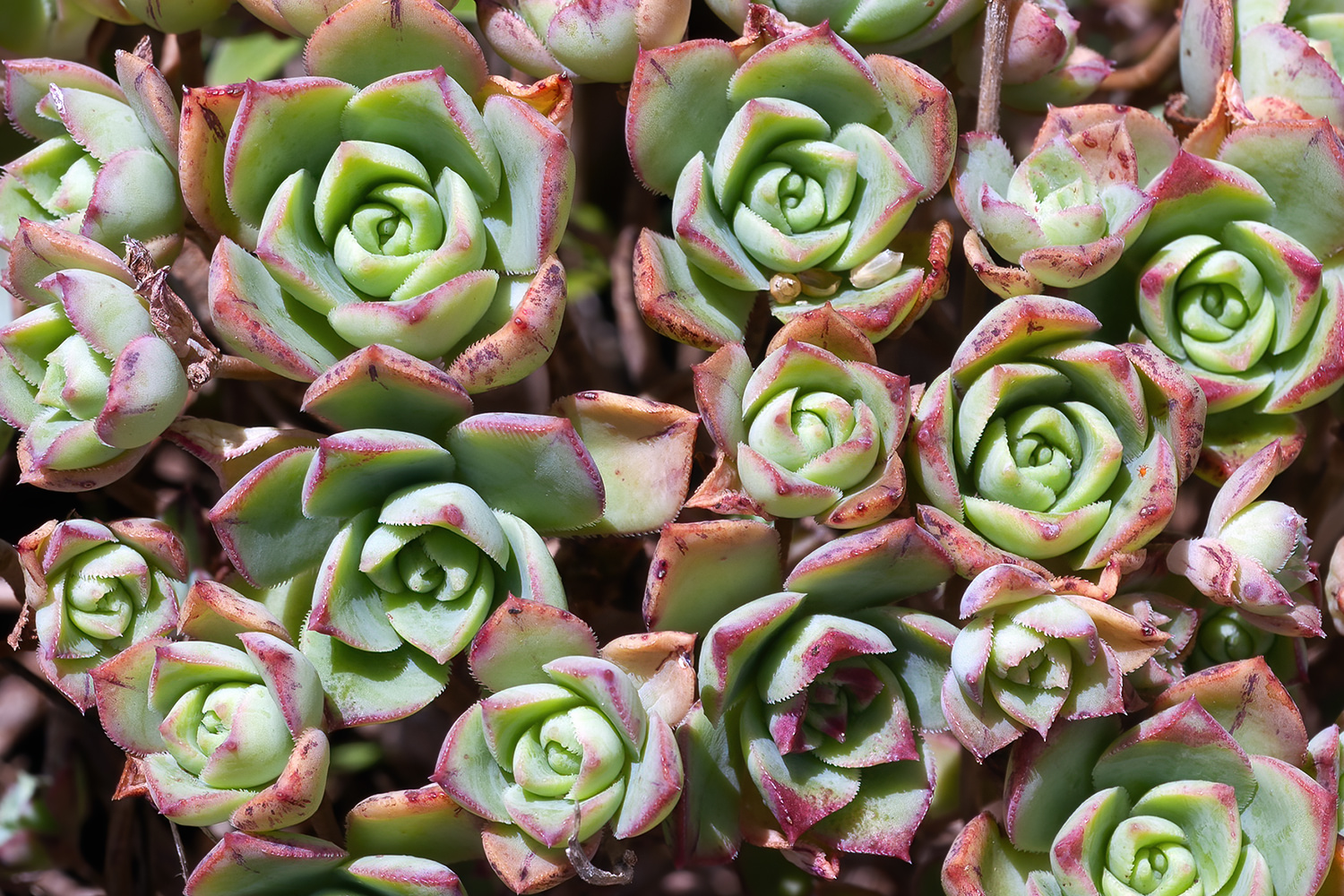
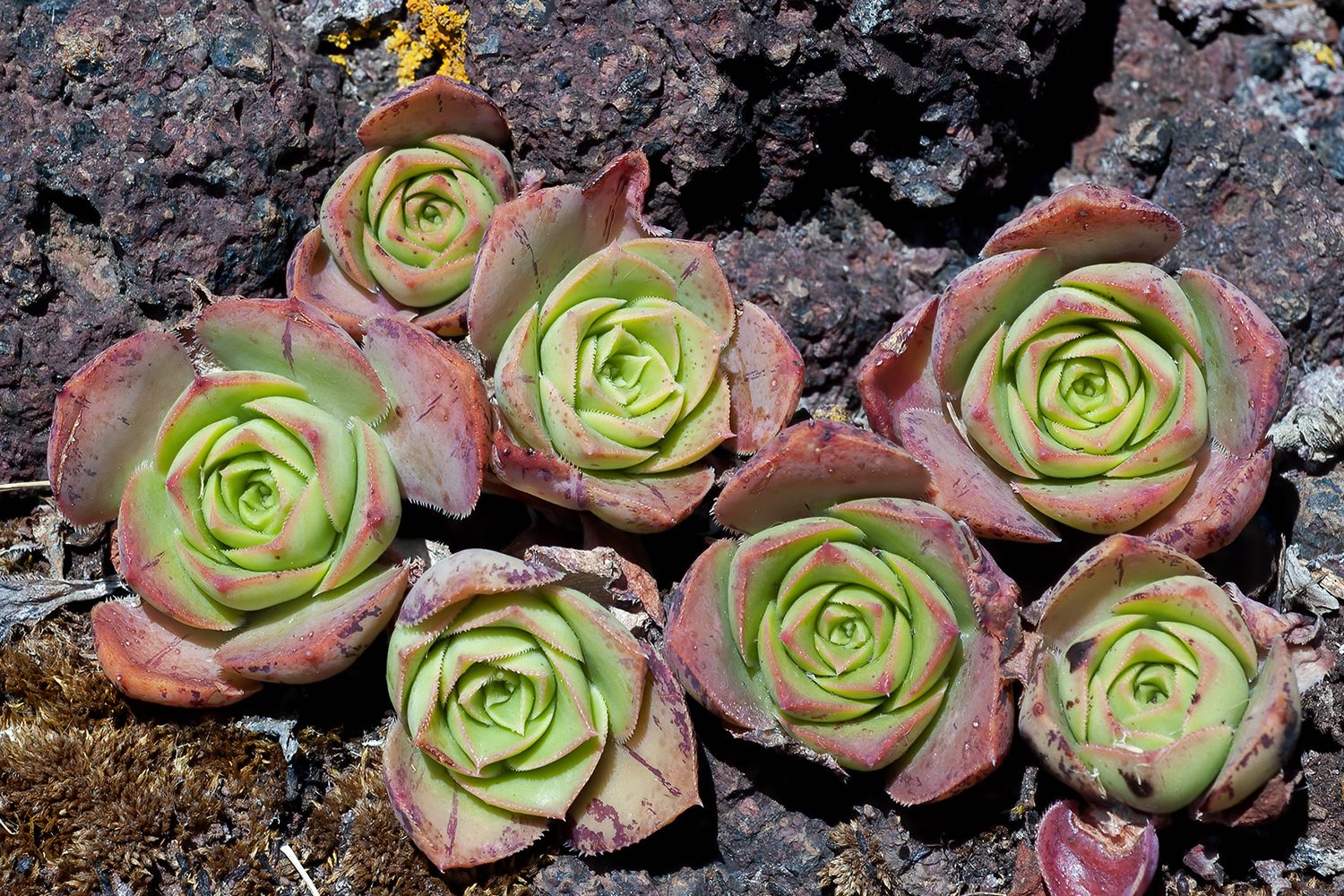
Its small, very fleshy leaves, about 3–5 cm long and up to 6–8 mm thick, are clustered in dense, diminutive terminal rosettes, between 3 and 10 cm in diameter. They are simple, smooth, more or less obovate, entire, bluish-green in colour, with ciliate margins and a reddish tinge.
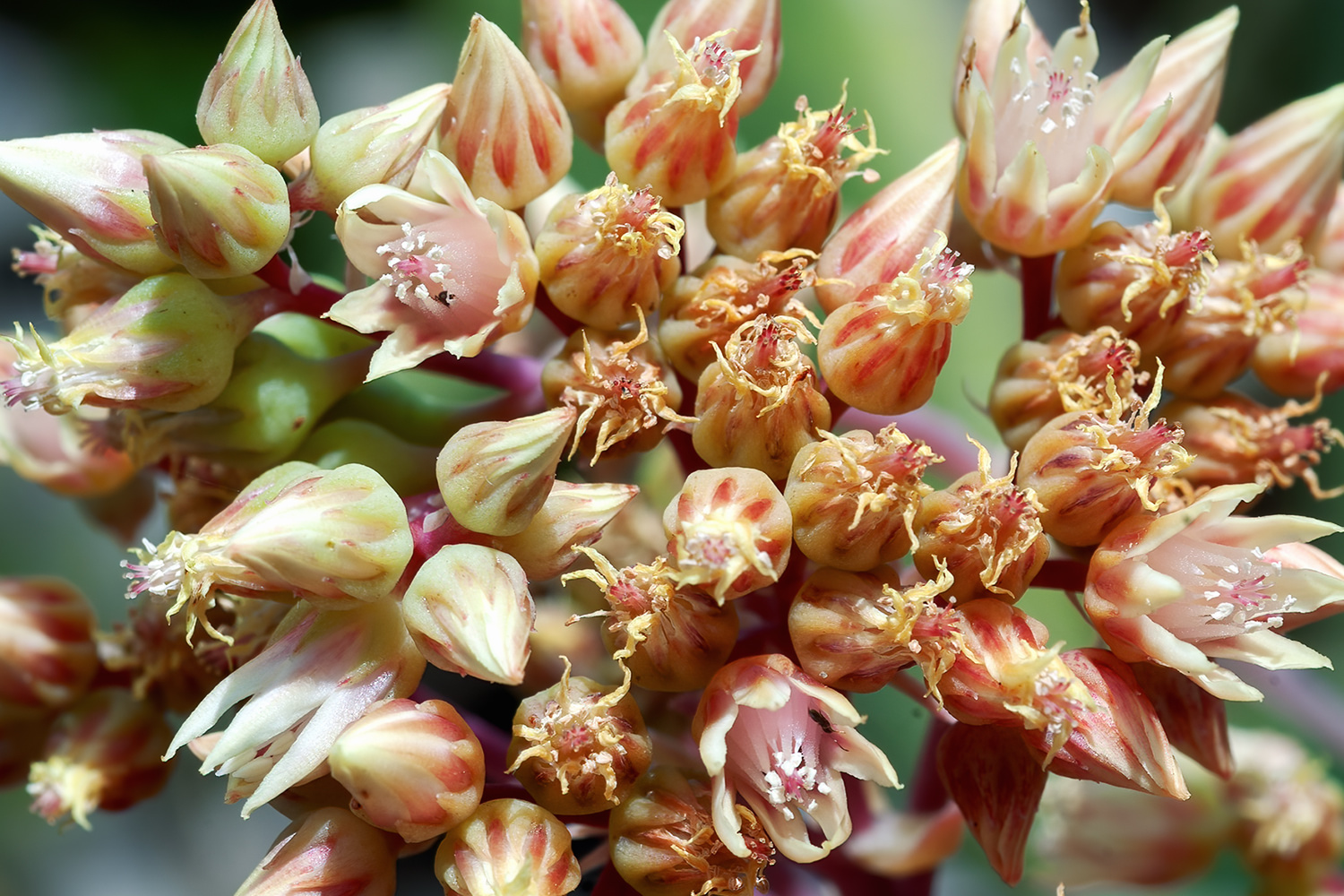
Its numerous greenish-yellow flowers, with pinkish hues, are grouped in branched, somewhat pendulous inflorescences, supported by a slender, fragile flower stalk covered in small leaves.
Each flower has between 7 and 9 triangular sepals, which are slightly serrated, glabrous and green or orange-red in colour; it also has the same number of whitish or pale yellow petals, which are lanceolate to elliptical, keeled, glabrous, serrated at the margins and up to 9 mm long. The stamens, which are twice as numerous as the sepals and petals, are slightly hairless, erect, with rounded anthers.
When ripe, they produce a vast quantity of tiny seeds that germinate very easily.
Its stems are slender, brittle and rough to the touch due to the scars left by dead leaves, and quite frequently produce numerous, slender adventitious roots.
Its small, very fleshy leaves, about 3–5 cm long and up to 6–8 mm thick, are clustered in dense, diminutive terminal rosettes, between 3 and 10 cm in diameter. They are simple, smooth, more or less obovate, entire, bluish-green in colour, with ciliate margins and a reddish tinge.
Its numerous greenish-yellow flowers, with pinkish hues, are grouped in branched, somewhat pendulous inflorescences, supported by a slender, fragile flower stalk covered in small leaves.
Each flower has between 7 and 9 triangular sepals, which are slightly serrated, glabrous and green or orange-red in colour; it also has the same number of whitish or pale yellow petals, which are lanceolate to elliptical, keeled, glabrous, serrated at the margins and up to 9 mm long. The stamens, which are twice as numerous as the sepals and petals, are slightly hairless, erect, with rounded anthers.
When ripe, they produce a vast quantity of tiny seeds that germinate very easily.
Habitat: Endemic to the north-western
region of the island of Tenerife, growing on rocky walls and slopes
situated between the lower edge of the laurel forest and the sublittoral
zone.
Although its current range is fairly limited, where it does grow it is relatively abundant, sometimes even colonising the walls bordering the cultivated terraces.
There are reports of its presence in the north-eastern part of the Anaga massif, where it is thought to be quite rare.
In some areas of Tacoronte, La Esperanza and La Laguna, there are small groups that have become naturalised, originating from specimens that were presumably planted for ornamental purposes.
Its presence has also been detected on the islands of La Palma and El Hierro, apparently as a result of specimens introduced from the island of Tenerife that have since become naturalised.
Although its current range is fairly limited, where it does grow it is relatively abundant, sometimes even colonising the walls bordering the cultivated terraces.
There are reports of its presence in the north-eastern part of the Anaga massif, where it is thought to be quite rare.
In some areas of Tacoronte, La Esperanza and La Laguna, there are small groups that have become naturalised, originating from specimens that were presumably planted for ornamental purposes.
Its presence has also been detected on the islands of La Palma and El Hierro, apparently as a result of specimens introduced from the island of Tenerife that have since become naturalised.
Flowering: Spring, usually between
April and May, with fruiting in summer.
Propagation: By seeds and cuttings.
Uses: Ornamental, although this practice should be restricted to its natural range to avoid the risks of genetic contamination that could arise from contact with populations of other species within its broad genus.
Furthermore, succulent plant collectors should refrain from collecting specimens, as this activity has a negative impact on its already dwindling populations.
Propagation: By seeds and cuttings.
Uses: Ornamental, although this practice should be restricted to its natural range to avoid the risks of genetic contamination that could arise from contact with populations of other species within its broad genus.
Furthermore, succulent plant collectors should refrain from collecting specimens, as this activity has a negative impact on its already dwindling populations.